
Anxious, much? Things seem a little out of control? Find a pig.
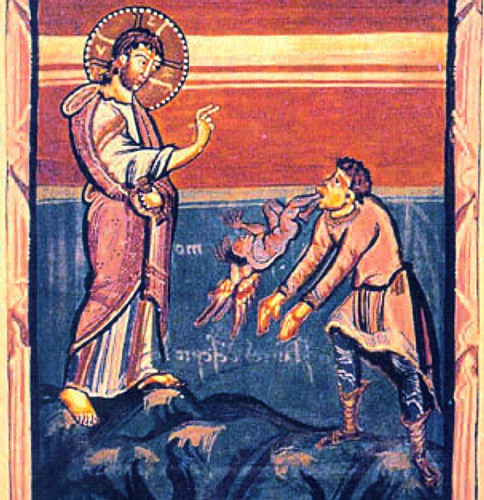
Knowing the Story
Let me confess up front: with regard to this project, I was in a sour mood this week. Bottom line, I didn’t memorize this story; and after recording a few thoughts, it lay fallow for a week. However, that will become a blessing, as related below.
Notes from The People’s New Testament Commentary
Legion: “A Roman military unit comprised of five thousand to six thousand men,” therefore by implication “a veritable mob of conflicting forces” causing the man to lose his personal identity.
Abyss: “the bottomless pit where demonic powers are confined by God” and therefore the story “represent[s] the final conflict between God and the demonic powers, in which they are vanquished forever.”
Telling the Story
Not having memorized it, I didn’t tell it. I do think it would make a dramatic telling.
Living the Story
A friend asked me, what good does it do to memorize Bible stories anyway? How does that work? Here’s one answer.
At 3:30 AM, September 5, I woke up, tense. I wandered out into the living room and saw a newspaper headline: “Arson arrest made in Mapleton blaze.” And I wondered if the motivation for that arson was somehow like the motivation for fires set in dumpsters and in federal buildings, in Portland, by rioters; some love for chaos, some anger or anarchy maybe? Then I read Heather Cox Richardson’s post for Friday 9/4/20, and learned that President Trump had described soldiers as “suckers and losers.” A well-sourced story, as it turned out.
And then my mind scrambled to remind me of all kinds of things. About the police who shot Jacob Blake, and the one who killed George Floyd. About riots in nearby Portland and about federal cops whacking a Navy veteran who just stood there and took it, and how the story of peaceful protests vanishes in the confusion, and how useful that is for people who want to spread a message of chaos and disorder.
And then my mind moves a lot closer. Tension with my siblings related to politics, and an interpersonal issue with a fellow writer. Also, why have I been coughing at bedtime and when awakening? Probably Covid. And then, old “flinch moments,” mistakes I’ve made along the way, like that game forty years ago where I got caught off first base because I was hot-dogging… worse things too.
I read a little in a devotional book and in the Bible. But anxiety does feel like a demon inside sometimes; something I can’t control, can’t shut off.
So I go back to bed. Can’t sleep.
I remember that sometimes reciting a Bible story to myself will put me to sleep. (Well, I’m sorry, Luke, but it does.) Alas, I didn’t memorize today’s story. In fact, I’ve spent a whole week without working on it at all. Whoops, there’s another of my personal demons: spotty self-discipline.
So I thought, if nothing else, I’ll bet I can tell myself the bones of the story. I start off, and it becomes a guided meditation, only the guide’s inside my head, in that place where unexpected thoughts originate. Since I couldn’t tell it from memory, it becomes improv.
I watch Jesus approach the demoniac. Luke’s picture of the demoniac becomes clearer when I cast Dwayne Johnson, the Rock, in the role. Impossible to hold! Breaks all chains and shackles! Lives in the tombs and the wilds, naked! (I give him a dirty white robe.) How dangerous this man is, how unpredictable and strong. The villagers are scared of this guy. I imagine the disciples are too.
On the other hand, this demon-driven wild man is scared of Jesus. By the end of the story, the villagers are too. And should be.
And the demoniac ends up at Jesus’s feet, “clothed and in his right mind.”
And Jesus gets asked to leave, “for [the villagers] were seized with great fear.”
Now I’m lying there and I’ve come to the end of the story and I’m still awake. So I think, if I were “in my right mind” instead of so anxious, what would that look like?
Well, the demoniac is a perfect metaphor… no, a perfect embodiment for today. We have a President who loves chaos. We knew that when he campaigned and he’s followed through on it. He’s immensely powerful.
So he’s there in the Gerasene man. But I also find there my strained personal relationships, and past mistakes and future troubles; and my inability to write anything or complete anything. And crowded into him are the guy who set the Mapleton blaze and the guy who shot two people in Kenosha and the police who shot Jacob Blake and the one who killed George Floyd, and the rioters looting, and how I’ve avoided protests for fear of COVID. He’s the pandemic and he’s the economic woes, and social isolation… I may be a bit more anxious than I realized…
So I picture Jesus calling him forward, bring all that to me he says, only I didn’t name all that, just saw the embodiment, the demoniac.
In my version, Jesus now says don’t be afraid of him, be afraid of me. Says it not to what’s human in this guy, but to the demons. Who are Legion. Many.
Then the demons come out… I see them one by one as they emerge, and of course as a modern person I name them in modern ways: Pandemic and Riots and Politics. What’s emerging is my fear of them, my guilt, my passivity, my discouragement relating to each of them. I recognize them and name them.
Now here’s the punchline. Here’s the good news. Jesus says to the demons, find a pig. Okay, that’s not how Luke tells it–the story says he “gave them permission” to enter the pigs–but happily, my guide is snarky and improvises dialogue for Jesus.
Jesus says, find a pig. I pick them up one by one–no names now, but amorphous anxiety–I take them by the tail and toss them pigward.They enter the pigs, and they rush into the sea–the chaotic sea–and drown.Jesus commands and they obey. No more demons.
And finally Jesus faces a new person, or at least a changed one, clothed and in his right mind.
I keep a pad near my bed to record late-night inspirations, because if I don’t write them down, I forget them by morning. I reach over and scribble in the dark: “find a pig.” Then, in my right mind, the legion hushed, I go to sleep.
The People’s New Testament Commentary: A very good, one-volume commentary on the New Testament. Fred Craddock and Eugene Boring are knowledgeable and succinct in explaining the text, and its historical and cultural setting. They’re less interested in defining Luke’s life lessons for you than Barclay, a commentator I also use.
Heather Cox Richardson: is a historian, professor, news gatherer, and commentator. Her post.

 Dave Raines, Writer